Bwindi Impenetrable National Park
Bwindi Impenetrable Forest National Park, a prime Uganda safari destination, is located in southwestern Uganda, with thick vegetation like its name suggests. Every day when tourists go out for the famous gorilla trekking adventure the ranger guides have to cut vegetation for trackers to access way to where gorillas nested the previous night. It is the true African jungle with droplets of the sun coming through the think forest cover giving you a feeling of being in paradise with zero pollution from several emissions common to our daily environment. The
Bwindi Impenetrable Forest was declared a UNESCO World Heritage site in 1994 because of its rich diversity in hosting different flora and fauna and being home to half of the worlds remaining mountain gorillas. The park covers an area of 321 km2 all of which is forested with some areas being covered by bamboo and shrubs. The forest lies on steep slippery valleys with ridges and hilltops.
The weather in Bwindi is chilly because of the immerse canopy, you are advised to carry some warm clothing for evenings and long sleeved shirts/trousers for trekking. For the ultimate experience to anyone who chooses to trek the mountain gorillas or search for birds, butterflies or shrubs, you need to be in good physical condition to go up and down the terrain. It lies at an altitude between 1160m-2607m above sea level.
Gorilla families in Bwindi Impenetrable Forest national park
Bwindi Impenetrable forest is divided into different trail heads where gorilla trekking tours happens. The gorillas habituated for tourism are in families based at different trailheads. When you choose to visit Bwindi, be sure to know which trailhead you are allocated before you book your hotel. After knowing your allocated trailhead then you can book the hotel in that location. There are currently 22 gorilla families habituated for tourism in Bwindi impenetrable national park. The different sectors in Bwindi are; Buhoma, Ruhija, Rushaga, and Nkuringo.
Wildlife in Bwindi Impenetrable Forest national park
Animals
The parks is home to about 120 mammals’ species that are rarely seen as they hide in the thickets of the dense forest. These include the large mammals and the very small mammals. The animals of Bwindi forest include; Elephants, duikers, buffaloes, golden cats, bush pigs, giant forest hogs, black-fronted Duiker, yellow-backed duiker, clawless otter, side-striped jackal, civet, numerous bats and rodents etc.
Bwindi forest is home to 11 primate species which are; black-and-white colobus monkeys, L’Hoest’s monkeys, De Brazza monkeys, Red-tailed Monkey, Blue Monkey, Potto, Demidoff’sGalago, Spectacled Galago, Baboons, Chimpanzee and the gentle giants of Bwindi – Mountain Gorillas.
Birds in Bwindi Forest
Bwindi impenetrable forest national park is home to about 350 species of birds. It is by the best place for birding in Uganda owing to its unique species of birds. The forest is home to 23 Albertine Rift endemics and 14 of which are recorded nowhere else in Uganda. The globally threatened species include, Grauer’s broadbill, Chapin’s Flycatcher, Shelley’s Crimson-wing. More species include; Handsome Francolin, Mountain-masked and Collared Apalis, White-bellied Robin Chat, Black billed Turaco, Fraser’s Eagle, Western Bronze-naped Pigeon, Purple-breasted, Blue-headed and Regal Sunbirds etc.
Birding in Bwindi happens mainly in the Mubwindi Swamp in Ruhija sector of the park, ‘The Neck’ a stretch of the forest joining Ruhija to the Buhoma sector and the Buhoma area especially on the waterfall trail.
Butterflies and Amphibians in Bwindi Forest
It is home to over 200 butterfly species including eight Albertine rift endemics. They include the African giant swallowtail and Cream-banded swallowtail. The amphibian species identified in Bwindi forest are 27 with 11 endemic to the Albertine rift. Fourteen snake species, 14 lizard species.
Things to do in Bwindi Impenetrable National Park
When most people think of Bwindi Impenetrable national park, they think of mountain gorilla trekking/tracking, which is rightly so because it is the main attraction. However, Bwindi being heavily dense rainforest, it is home to many birds and animals and several other activities.
Gorilla Tracking in Bwindi national park
Bwindi is home to half of the world’s remaining mountain gorillas. Gorilla tracking is done daily after purchasing a gorilla-tracking permit from the Uganda Wildlife Authority. You are advised to book your permit at least 3 months prior to secure your day especially if you prefer a certain location. Only 8 individuals from 15 years of age are permitted to visit a gorilla family per day. You need to be in good health condition otherwise you will not track because humans and Gorillas can easily pass diseases to each other. You will be briefed by your guide way before tracking and advices to stay at least 8m from the gorillas, do not use flash photography and do not look directly in the eyes of the gorilla for an extended period of time. You need to wear long sleeved pants and shirts to avoid scratches as you trek through the forest, carry a rain poncho, seasoned boots, lots of water, lunch (sometimes it takes an entire day to locate them) and finally consider hiring a potter because the terrain can be difficult.
Bird watching in Bwindi national park
Bwindi forest is a prime Uganda birding spot and was named as Africa’s number one birding spot by Africa Bird Club. If you have limited time in Uganda and you must choose only one park for birding then, Bwindi should be your choice. It is easily accessible for birding with birding trails in the forest leading to different area including the waterfall trail. It is home to about 350 species of birds which include 23 Albertine Rift endemics and 14 of which are recorded nowhere else in Uganda. There are excellent site guides in the communities who are very knowledgeable about the birds in the area especially the endemics. These join you as you take your trip into the forest re-enforcing the team you will have started with on your trip.
Nature and waterfalls walks in Bwindi national park
There are various trails into the forest for your different interests. You have trails leading to beautiful waterfalls where you can dive in the water. You walk along with an armed Uganda wildlife ranger guide for your protection in case you meet a wild animal but also as a guide. The available trails; Buhoma – Nkuringo trail which takes 4 – 5 hours crossing through the national park. Rushura Hill walk – a trail through forest shared between Congo and Uganda. Muyanga waterfall walk, Ivi River Walk – 14 kms and takes about 7 hours. Muzubijiro Loop – 6km walk around the hill where you have chances of interacting with primates and birds.
Mountain Hiking and biking
Kigezi region where Bwindi impenetrable forest is located is a mountainous area with beautiful scenery. Most lodges have bikes you can rent per day to take on the special trails created in the community otherwise ask them for a project you can rent from.Ivi river trail from Buhoma park headquarters to Ivi river organized by ‘ride for a woman’.
Community walks and Cultural experiences
The community surrounding Bwindi forest is full with activities and cultural experiences for you. You can choose to take on the Batwa experience – a people that lived in the forest for many years. Here you will be to re-visit the forest with them and experience how they lived in the forest, how they co-existed with the gorillas and the other animals for years. The different walks include Buniga Forest nature walk in Nkuringo – a forest reserve adjacent to Bwindi impenetravle national park. Nyundo community Eco trails and King Bakyara’s waterfall trail. Tour the village Aquaponics project with Conservation through Public Health (CTPH). Buhoma community tours – areas of interest, handcraft shops, Batwa community, traditional healer, primary school and finally learn how bananas are used to make juice, beer and gin and taste.
Accessing Bwindi Impenetrable National Park
There are scheduled/ charter flights from Entebbe International Airport to Kihihi town connecting to Buhoma area or to Kisoro Airstrip, which connects to Ruhija, Nkuringo and Rushaga. There are also flights from Kajjansi Airfield, which lies between Kampala and Entebbe.
Driving: From Kampala, the route depends on the trailhead you are visiting i.e. Kampala – Kabale – Ruhija OR Kampala – Ntungamo – Rukungiri – Kihihi – Buhoma/Nyondo OR Kampala – Kabale – Kisoro – Rushaga/Nkuringo.
Kibale Forest National Park
Kibale National Park is an attractive park in Uganda with varied tracts of tropical rain forest and a multiplicity of animals located in western Uganda slightly off the Equator. The annual temperature ranges between 14-27C and is generally cool. It is the ultimate place for chimpanzee trekking in Uganda.
It is known as the “primate capital of East Africa” with 13 different primate species. Kibale forest is home to more than 1,450 chimpanzee protected within its borders of 795km2 area covered. It is by far the best place to see Chimps in East Africa. The chimpanzees have been habituated for over 26 years giving you a chance to see the great apes in their natural environment. Children have to be 15 years and above to track the Chimpanzees. If younger they can opt to see chimpanzees at Ngamba Island Chimpanzee Sanctuary located off Lake Victoria in Entebbe – there is a raised platform where visitors can view the chimps as they come from the forest for their midday snacks.
The forest’s varied altitude supports different habitats; woodland, Savannah, wet tropical forest and semi-deciduous dry tropical forest which gives the park opportunity to host different wildlife that reside in the different habitats.
Wildlife in Kibale National Park
Animals in Kibale national park
The mammal species in Kibale forest are estimated at 60 and include leopards, Duikers, Forest Elephants, Forest Buffaloes, Golden cats, Warthogs, and Bush Pigs. Generally animals found in the forest are shy and more aggressive maybe because of the vegetation as also because fewer people visit the parks compared to savannah parks that are usually teeming with people. On a lucky day you might sight a few Elephants, Buffaloes or Bush Pigs but normally you will only find their footprints because they tend to move away when they detect activity in the forest.
The main attraction in the forest is searching for chimpanzees with activities of chimpanzee trekking and chimpanzee habituation experience being the reason why most people visit Kibale national park. The park is host to 13 primate species that include; bush babies, L’Hoest’s monkey, red colobus monkey, red-tailed monkey, black-and-white colobus monkey, grey-cheeked mangabey, olive baboon, blue monkey, Vervet monkeys and Potto.
Birds in Kibale National Park
Kibale forest is a prime birding spot and is home to over 375 bird species including six endemic to the Albertine Rift area. It is an excellent birding spot because of its varied habitat and dense vegetation that give birds a safe haven and plenty of food to feed on. Birding usually happens early in the morning and late evenings for the nocturnal birds.
Green breasted Pitta is one of the main attraction for birders visiting the park. Other bird species to look out for include; Red-chested owlet, Purple breasted sunbird, African Grey Parrot, Blue-breasted Kingfisher, Crowned Eagle, little Greenbul, Black Bee eater, White-naped pigeon, andScaly-breasted Illadopsis,Western bronze-napped Pigeon, Nahan’s Francolin, Yellow-throated Nicator, White-headed Wood-hoopoe, Red Headed malimbe , Yellow-spotted barbet , Dusky-blue Flycatcher etc.
Amphibians and Butterflies in Kibale National Park
The park is home to over 250 species of butterflies, several reptiles, and amphibians. You need to be keen to spot the reptiles and amphibians but the butterflies will be ‘all over the place’. As you hike through the forest in search of chimpanzees and other primates, enjoy sighting the different colourful butterflies.
Safaris and Activities in Kibale National Park
Chimpanzee Trekking in Kibale National Park
Chimpanzees are the prime attraction for many visiting Kibale national park. Chimpanzee trekking has been happening in Kibale forest since 1993. Chimpanzee trekking is done twice a day i.e. early morning at 8am and afternoon at 2pm, therefore you have an opportunity to choose which time is conducive for you but morning is highly recommended. You will meet for briefing from the ranger guide before the trek starts to hear and learn about the expectations while in the forest and about other wildlife in the park. Trackers go before you and search for where the chimps nested the previous night and where they are located, they then relay this information to your ranger guide to lead you towards their location – remember the Chimps keep moving so they give the rangers information on the go. You need to be ready to walk long distances and carry along rain poncho because in a tropical forest it can rain anytime. Other items include long sleeved shirt and pants, comfortable waterproof boots, binoculars, camera, insect repellant.
Chimpanzee Habituation Experience in Kibale National Park
Chimpanzees are habituated over a period of 2 years before they get used to humans and then chimp tracking can begin. The CHEX (Chimpanzee habituation experience) happens every morning, a visitor goes along with the rangers and research staff and watch chimps leaving their overnight nests before they start their daily activities, feeding, hunting, copulating, breastfeeding, patrolling and resting. When this process is repeated over time, the Chimps get used to humans and that family is included on those that can be tracked.
Bird watching in Kibale National Park
Birding in Kibale forest is a rewarding experience, bird walks start at 7am every morning but you need to book early so the rangers are expecting you. The park is home to a variety of birds including the Albertine rift endemics. Morning focus for any birder in Kibale forest is to search for the Green breasted pitta. Other species includeGrey-throated FlycatcherGrey-winged Robin, Crested Flycatcher,Blue shouldered Robin Chat, Yellow-spotted Barbet, Black-billed Turaco, White-naped Pigeon, Red-chested Fluff tail, White-collared Olive-backWhite-bellied, Masked Apalis, Nahan’s Francolin, Tiny Sunbird, and many more.
Nature and Hiking walks
The forest is rich in variety and the chimpanzee trekking may not give you enough time to take in all that the forest offers because you are focused on location the chimps. There is an option of a 12km hike through the forest. Here you are able to spot more variety of birds and animals. On a lucky day, you may encounter bush pigs, Duikers, and Elephants. This is available in the dry season (December – February and June – September) because the wet season most of the trail is impassable. There is also an option of night walks to see the nocturnal when the other forest inhabitants rest. The rangers use powerful torches to seek nocturnal such as bush baby, hyrax, potto and occasionally serval cat and civet. These walks last 2.5 hours and leave at 7pm.
Community walks and Cultural experiences
There are several community initiatives and cultural experiences to engage in once you visit Kibale forest. Bigodi Wetland sanctuary is a community initiative to preserve the rich eco system along the wetland. The wetland is a birders haven with about 138 species. Magombe swamp which hosts eight species of primates. All these are under the management of the community. Visit a women’s project, where you can purchase handmade crafts to support them. Prepare, and or enjoy a traditional meal at Tinka’s place. Visit a local school.
Accessing Kibale National Park
You can access the park from Entebbe International airport for scheduled/charter flights to Kasese Airstrip which is an hour from Kibale national park or drive from Kampala via Fortportal to Kibale forest ( recommended direct route). Alternatively, Kampala – Mbarara – Kibale forest via Ibanda (in case you have a stopover there for an activity) and finally from Queen Elizabeth national park – Kasese – Fortportal – Kibale forest or Queen Elizabeth national park – Kasese – Kasekende craters – Kibale national park.
Murchison Falls National Park
Murchison Falls National Park at 3840km2 is the largest park in Uganda ripe for exploring with safaris to this beautiful park. It is named after the Murchison falls where the mighty river Nile is forced through a narrow gorge of 7m into the ‘Devils Cauldron’ creating an ever present rainbow. Samuel Baker the explorer considered the Murchison falls as “the most important object of the entire course of the river” named the waterfall in 1864. The park is only 4 hours away from Kampala the capital and with all the attractions is a perfect destination for an exciting Uganda safari. The habitats range from forest, savanna, riverine woodland, borassus palms, and several acacia trees.
It lies in the northern end of the Albertine Rift Valley giving it great views of the plains and forested areas and the Victoria Nile that pours into Lake Albert. The Albert Nile Corridor is Uganda’s lowest area at 612msl at the Delta. You have opportunity to view the falls from up as the Nile squeezes through the gorge and from below while on the boat safari on Victoria Nile. The Launch trip on Victoria Nile gives you an opportunity to experience the Nile like the actors of the 1951 film “The African Queen.”
Wildlife in Murchison Falls National Park
Animals in Murchison Falls National Park
Murchison Falls NP has 76 species of mammals that call this their home including four of the big five. To have a complete big 5 list, you would need to pass by the Rhino Sanctuary on the way to the park.
Animals are often seen while on a boat safari and during game drives in the park. The more common animals often seen are; Elephants, Giraffes, Buffaloes, Uganda Kobs, Bushbucks, Jacksons Hartebeests, Oribi, waterbucks and warthogs to mentions but a few. The big cats of Leopards and Lions have higher chances of being seen when you early morning for a game drive before the sun is too much to force then into hiding. It is also home to several primates including Baboons, Patas monkeys, Blue monkeys, Red-tailed monkeys and Black-and-white Colobus monkeys and Chimpanzees are found in the forested area of Kaniyo Pabidi which is part of Budongo forest.
Birds in Murchison Falls National Park
Murchison falls national park has varied habitats for birds making bird watching a famous activity in this park which has over 450 species of birds. The park is home to many migrant birds and those that are there all year round. The park has forested, swampy areas, riverine woodland, Savannah and acacia trees which all provide habitats for the birds. You will enjoy the waterbirds when you take a boat safari towards the delta or towards the Murchison falls. Some bird species found here include; the elusive Shoebill, Swamp flycatcher, papyrus Gonolek, Goliath Heron, Abyssinian Ground Hornbill, Northern red bishop, Squacco heron, Red-throated Bee-eater and African-Quail Finch etc.
Safaris and Activities in Murchison Falls National Park
Game drives in Murchison Falls National Park
Uganda Wildlife Authority has demarcated tracks on the northern bank of river Nile for game drives. On your safari in Murchison falls national park, you will take the game drives in the custom-made tour vehicles with open roof so that you can easily spot the animals. Everyone should have access to a window for easy viewing.
The game drives takes anything from 4 hours to an entire day depending on your interests, amount of time in the park and the different activities you are interested in. Have your cameras to shoot photos of the different animals, birds and landscape but most importantly use the time to enjoy nature. The animals to look out for include; Bushbucks, Waterbucks, hartebeest, Oribi, Uganda Kobs, giraffes, Patas monkeys, Warthogs, Elephants, Buffaloes, Leopards and Lions etc.
Boat safaris on the Nile /Launch trips on the Nile
The boat safaris in Murchison Falls national park are on the Victoria Nile towards the falls. The Nile boat safari is your ultimate experience of water, animals, birds, and great scenery. Here you look out for animals coming to water and those resident/semi residents in water; Crocodiles, Hippos, monitor lizards. Watch out for herds of Buffalo, Elephants and antelopes that come for water.
The opportunities for water birds are high as you take this trip. The launch trip happens twice a day with a morning trip starting at 9am and afternoon at 2pm; however, one can rent a boat and take trip at their leisure. For those most interested in bird watching we recommend the boat ride to the delta where you have chances of sighting the Shoebill as it fishes.
Chimpanzee tracking at Kaniyo Pabidi in Budongo Forest
Kaniyo Pabidi is a section of Budongo forest located in the boundaries of Murchison falls national park. You can track chimpanzees from Kaniyo Pabidi a section of Budongo forest, which is home to numerous other primates like baboons, red-tailed monkeys, black-and-white colobus monkeys and blue monkeys, lots of rare bird species and big game like Buffaloes, Elephants, and bush pigs with magnificent scenery.
The chimpanzee trek normally takes 3-4 hours depending on where the chimps nested the previous night, once located the people are can stay in the presence of chimps for an hour watching them eat, play, rest and groom each other. This needs to be booked in advance with Uganda wildlife authority or Budongo Eco Lodge.
There is also an opportunity for a full day Chimpanzee habituation experience which gives more time learning and watching the chimpanzees – this also has to be booked prior to your safari.
Sport fishing
Sport fishing is allowed on the Nile after obtaining the permit from Uganda Wildlife authority through your tour operator. The waters after the falls on Victoria Nile provide some of the most exciting challenge to anglers with presence of Nile Perch. The largest Nile perch recorded is 108kg. Fishing is permitted in designated sites and places which require prior booking. You are encouraged to bring your own equipment.
Birdwatching in Murchison Falls National Park
Murchison falls National Park with 450 bird species was named No. 9 best birding spot in Africa by the Africa Bird Guide. Bird watching can be done while on game drive, launch trips and nature walks with a ranger guide. Because of the varied habitats, you have opportunities of watching forest birds, Savannah, water and a few of Albertine rift endemics.
Birds in Murchison Falls national park are easy to find because of the its Savannah grassland. However some woodlands and forested areas make it difficult but still possible to locate the birds. The highlights will be the numerous birds by the waters and swamp areas like the; open-billed stork, Red-throated bee–eaters (nests in the cliff by the river), Pied, malachite and Giant Kingfishers, Grey, night, commom Squacco, Striated and Goliath herons, Egyptian ducks, Spur winged lapwings, Intermediate, Great and Little Egrets. While on game drive do not miss the Abyssian ground hornbills, Black and Northern Red Bishop etc.
Nature and forest walks
Most of the nature walks happen through the forests, Kaniyo Pabidi and Rabongo forest where you have opportunities of watching the primates such as Chimpanzees, black-and-white colobus monkeys, red-tailed monkey, and numerous bird life.
The Hike up the top of Murchison falls is another exciting walk that everyone should take. Once on the boat trip from Paraa toward the ‘Devils cauldron’, stop a few meters from the bottom of the falls and take hike through the vegetation to experience the top the falls. The hike is fulfilling as you watch the waters of the Nile be squeezed through a 7m gorge. This hike takes any thing between 45 minutes to 1.5 hours depending on the interests of the people and their speed at hiking.
Community walks and Cultural experiences
The Boomu women’s Group right outside the park is a worthy visit for someone who wants to engage with the local community. Take the scenic village tour as you learn about the residents everyday lives, farming, visit the black smith, demonstration of basket weaving, cooking and visit to a local school. You can choose to stay over night in this place or just visit for a few hours and continue to the park or when leaving for Kampala. The activities will depend on how much time you have to in the area.
Accessing Murchison Falls National Park
You can access the park by taking scheduled/chartered flights from Entebbe International Airport or drive from Kampala, which takes approximately 5 hours. The park has access gates from the south for people traveling from Kampala through Masindi or those traveling from Fort portal. It also has access gates in the north for people traveling from Kampala via Karuma or those traveling from Gulu or Kidepo valley national park.
Queen Elizabeth National Park
Queen Elizabeth National Park, named after Queen Elizabeth II of England after her visit in 1952, is one of the top Uganda safaris destinations. It is located in southwestern Uganda and lies astride the Equator with monuments on both sides of the road making latitude 00. It is in the Albertine region along with Kyambura and Kigezi wildlife reserve, which brings together the most diverse ecosystem in Africa. The rich bio-diversity of crater lakes, forest, savannah, woodland, and acacia and numerous animal, plant, and bird species lie on an area of 1978km2. This is the most visited park in Uganda which maybe because of its name but also is easily accessible for those traveling with public transport.
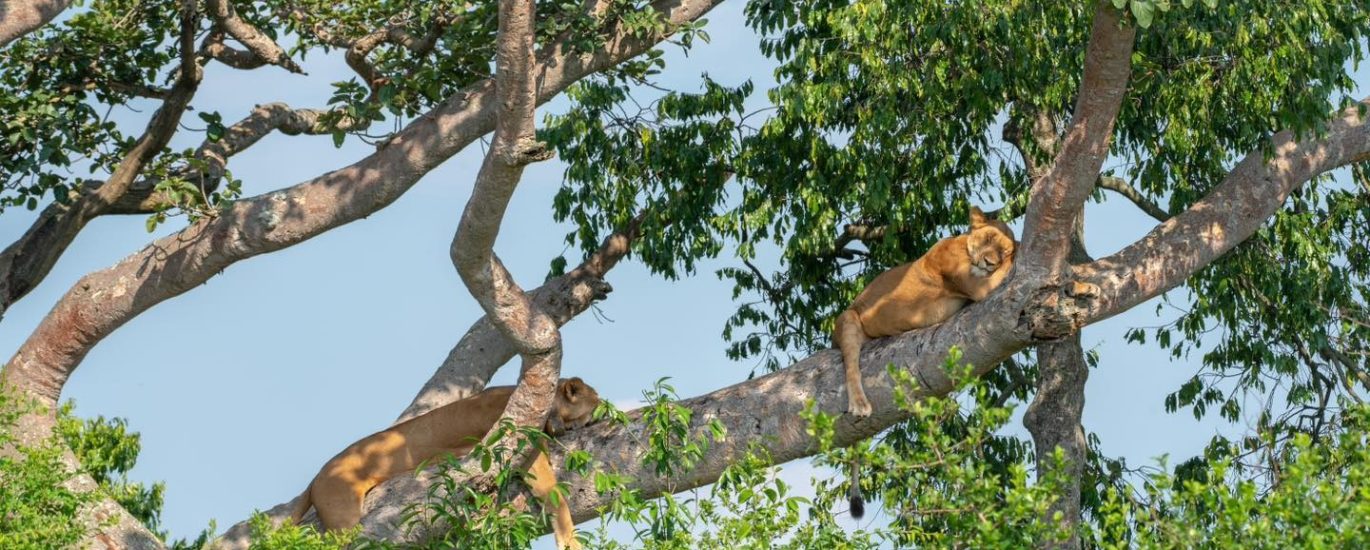
Numerous crater lakes in Queen Elizabeth give incredible scenery. Have stopovers at Nyamununka crater lake also known as the hospital for animals, many visit it to have their wounds treated or the aging animals for its waters that contain Sulphur. Take a trip to the salt mining craters, Lake Katwe or Lake Bunyampaka. Enjoy the sun set over Lake Edward and Rwenzoris in the backdrop. Ishasha sector of Queen Elizabeth national park is home to the famous tree-climbing lions that choose the branches of acacia trees after the night/early morning meals. The trees also provide the needed shed from the scotching sun which raises them to experience the winds.
Wildlife in Queen Elizabeth National Park
Animals in Queen Elizabeth National Park
The park is home to over 95 mammal species, which are the main attraction of the visitors to the park. It has four of the ‘Big Five’ namely Elephant, Leopard, Lion and Buffalo. It is home to thousands of hippos that populate the water shores of Kazinga Channel, which connects Lake George to Lake Edward – known to have the largest herd of hippos. The park is an open Savannah spread with acacia and euphorbia trees that provide a habitat for leopards, elephants, lions, Uganda kobs, Topi, hyenas, and big herds of buffaloes, large families of banded mongoose, warthogs, bushbucks and waterbucks.
Chimpanzees and other primates are found in the adjacent Kyambura gorge and ‘underground forest’. Look for the black-and-white colobus monkeys, red-tailed monkeys, olive baboons etc.
Birds in Queen Elizabeth National Park
Queen Elizabeth national park is a birdwatchers haven with over 600 bird species and is an important Birding Area (IBA) according to Birding International. It has the highest number of birds found in any protected area in East Africa.
The park has diverse habitat for birds from Savannah, numerous crater lakes, forests and woodland. There are different sections where you go birding i.e. Kasenyi area, Mweya peninsula, Imaramagambo and Kazinga channel. The bird species to look out for include, African mourning dove, Swamp flycatcher, Grey headed kingfisher, pin-tailed whydah, slender-tailed nightjar and collared pratincole. Look out for the flamingos at the salt lakes of Katwe and Bunyampaka.
Safaris and Activities in Queen Elizabeth National Park
Game drives in Queen Elizabeth National Park
Early morning or evenings are the best times to go game viewing mainly because the sun is not as hot and the cats prefer to hunt during these periods.
The game drives in Queen Elizabeth national park happen mainly in the Kasenyi area, which has the largest Kob mating ground. The area is famous for big cats because of the high population of Uganda Kobs which they prey on. Look out for herds of buffaloes and elephants as they graze through eh Savannah. The game drives are in custom-made vehicles for safari where each occupant has access to a window seat and open roof.
Boat safaris on Kazinga Channel / Launch trips
Kazinga channel is a stretch of water connecting Lake Edward and Lake George provides a fantastic game and bird viewing experience. You have sightings of Elephant as they take water and schools of Hippos as they guard their territories. There are boat safaris happening from the jetty that last between 2 – 3 hours leaving both in the morning and the afternoon. There are shared boats but you can choose to hire private boats for you and your party.
Other animals you are likely to see are monitor lizards, crocodiles, waterbucks, buffaloes, Elephants, bushbucks etc. The bird life is excellent with numerous bird species. The launch trips are twice daily i.e. morning and afternoons but for birding trip we recommend the morning boat which gives you better opportunities for bird watching.
Chimpanzee tracking in Kyambura Gorge
The park hosts the Kyambura gorge which is an ‘underground’ forest 100m below the Kichwaba escarpment. It is home to ten primate species including the famed chimpanzees, olive baboons, black-and-white colobus monkeys, etc. Chimpanzee tracking has to be booked in advance from the park headquarters. The chances of sighting the chimpanzees are not high but nevertheless the experience trekking through the forest is amazing as you have many other sightings of beautiful birds and other primates.
Bird watching in Queen Elizabeth National Park
The park is great destination for birding in Uganda as it hosts 600 bird species. Lake Munyanyange adjacent to the park is a bird sanctuary as well as a migratory location for the lesser flamingo from August to November.
Other areas for birdwatching include the Kasenyi plains, launch cruise on Kazinga channel, Kyambura gorge Mweya peninsular, Maramagambo forest, Katunguru bridge and various lakes in the park. Generally, every corner of the park is a great bird watching area. The birds are relatively easy to spot and you can expect great photo shots as you explore the park and its environs.
Nature and forest walks
These are done with a ranger guide for purposes of safety. They are available at the Mweya peninsular where you have a great birding and views across Kazinga channel and Lake Edward. In Ishasha, you have an opportunity to walk along Ishasha River where you have an opportunity to get close to the Hippos with your ranger guide. Maramagambo forest is another site with the famous bat cave and several bird species.
Community walks and Cultural experiences
In addition to the amazing wildlife, Queen Elizabeth has a rich cultural history with a lot of fishing villages adjacent to the park. Visitors have opportunities engaging with local communities and enjoying the stories, music and dance Or engage in the daily activities of the locals like harvesting and cooking a quick vegetable meal and making crafts.
There are also communities adjacent to the park that you can visit to learn about their initiatives and others to do community walks that allow you learn a bit more about their culture.
Kikorongo Women’s Community Project offers cultural performances of dance, drama, music and fire-making, basket weaving, paper beads. You would need to book before visiting because the women are not at this project daily but many will be in their farms where they spend most of their time.
Nyanzi’ibiri Cave Community – view of scenery around the cave. Historical cave and museum, paddle a canoe, hike to the transparent lake, spot primates and birds and a taste of local foods – from farm to plate.
Agro-tour walk
Locals living in the Kichwamba escarpment, which makes up the eastern arm of the western rift valley, have an agro tourism project where they take interested visitors to their farms showing you the local farming methods. You walk through the village sighting birds, medicinal plants and learn about how they combat the human wildlife conflict as their farms border the national park.
Accessing Queen Elizabeth National Park
Access Queen Elizabeth national park from Entebbe international airport using scheduled/charter flights and these land inside the park at Mweya Airstrip. Otherwise, you can drive from Kampala via Mbarara to the park OR Kampala via Fortportal to the park.
Mgahinga Gorilla National Park
Mgahinga Gorilla National Park is the smallest park in Uganda covering an area of 33.7km2. It is located in the southwestern tip of Uganda in Kisoro district. The park adjoins Rwanda’s Volcano national park and the Democratic Republic of Congo’s Virunga national parks and is part of the Virunga conservation area. The park takes its name from “Gahinga” – the local word for piles of volcanic stones cleared from farmlands. It covers an altitude between 2227m – 4127m above sea level. While in the park, you will experience six vegetation types, Afromontane, tree heathers, montane forest, bamboo, montane woodland, and former farmland.
The Virunga ranges have eight volcanoes and three of the conical peaks are in Uganda’s Mgahinga Gorilla national park. Muhabura is the highest at 4,127m – the name is translated ‘guide’ in the local language, they used it as a reference to give direction because it towered above everything else. It has panoramic views of Uganda and Rwanda with a clear lake at its summit 36m wide. Gahinga at 3,474m is also the smallest of the Virunga volcanoes; its name is derived from the ‘piles of rock’ that are cleared from farmlands. It has a swamp-filled crater on the top that measures about 180m wide. Finally Sabyinyo at 3,669m is translated ‘old man’s teeth’ because of the deep gorges and ravines that dissect it. On the highest peak of Sabyinyo is where you find the intersection between Uganda, Rwanda, and Democratic Republic of Congo. You can take a hike to all these peaks in one day; you will be rewarded with magnificent views and great photographic moments.
Gorillas in Mgahinga Gorilla national park
The main attraction in the park is gorilla trekking just like its names suggests. The park has only one habituated gorilla family called Nyakagezi gorilla group with a Silverback Bugingo who is about 50 years old and leads the group. The rest of the gorillas have not be habituated for tourism.
Wildlife in Mgahinga Gorilla national park
Animals of Mgahinga Gorilla national park
Mgahinga Gorilla national park is home to 76 mammal species but many are difficult to see in the wild because of the vegetation. Look out for bush pigs, South African porcupines, forest buffaloes, bushbucks, forest Elephants, golden cats etc. The main animals that bring people to this park are the endangered mountain gorillas and the golden monkeys.
Birds of Mgahinga Gorilla national park
Mgahinga Gorilla National Park is home to about 180 bird species with some of the spectacular Albertine rift endemics. The park has varied montane habitats, which provide an excellent home for the different birds. The bird species in Mgahinga gorilla national park include Kivu Ground Thrush, Cinnamon Bracken Warbler, White Starred Robin, Rwenzori Turaco, Rwenzori Batis, Archer’s Robin Chat, Olive Pigeon, and Black headed waxbill, Western Green Tinker bird, Cape Robin. More species include; White-starred Robin, Brown Woodland Warbler, Striped breasted Tit, Malachite, Scarlet-tufted, Greater Double collard Sunbirds
Safaris and Activities to Mgahinga Gorilla National Park
Gorilla Trekking in Mgahinga Gorilla national park
Gorilla tracking like all activities in Mgahinga gorilla national park is done on foot because the park is mainly mountainous. Early morning you will get to the starting point – Ntebeko gate at 8am where you receive a briefing about the expectations while you are tracking gorillas in Uganda. Your ranger guide will go ahead of you sharing stories of the gorilla highlands in Uganda. You will learn about the different members of the Nyakagezi family and general gorilla behaviors. The ranger will be in touch with the earlier trackers who will share information on where the gorillas nested the previous night. Once they are located – you have an opportunity to spend upto one hour in the presence of gorillas. Remember that should you have a communicable disease, you will not be allowed to track gorillas to avoid likelihood of passing on the disease to the gorillas. Carry long sleeved shirts, trousers, garden cloves, sun hat, rain pocho, and insect repellant and sturdy boots.
Golden Monkey tracking Mgahinga Gorilla national park
The other main activity in Mgahinga gorilla national park is golden monkey trekking. In Uganda, this is the only place you can track golden monkeys, which are also endangered and endemic to the Albertine rift valley. There is an estimated 3000-4000 individuals in the Virunga area of which 40-65 are habituated in Mgahinga gorilla national park. You will start your journey to track these beautiful primates with your ranger guide after a briefing. You need to be averagely fit to transverse the mountainous area because unlike gorillas which can in the same area for a while, golden monkeys tend to move a lot.
Bird watching Mgahinga Gorilla national park
Mgahinga offers excellent bird viewing opportunities with different trails. The gorge trail lies between Gahinga and Sabinyo takes about 3 hours for birders. Species to look out for while on this trail include Brown-crowned Tchagra, Rwenzori Batis, Black-headed Waxbill, Cape Robin-chat, and Bronze, Regal and Blue-headed Sunbirds.
You can in addition take on the bamboo trail, which starts from 2500m above sea level. Here you have increased chances of sighting the Rwenzori turaco, Banded Prinia, Doherty’s Bush-shrike, Red-faced woodland warbler and Chubb’s cisticola.
Nature and Hiking walks
Hike up Gisozi hill and experience great views of Kisoro and Bunagana town as well as Lake Mutanda. You will also view the Calderas while atop this hill.Walk along Congo border and transcend different vegetation zones.
Mountain and Volcano climbing
The Virunga volcanoes are a chain of eight volcanoes, which dot the borders of Uganda, DR Congo, and Rwanda. Three of the conical peaks are in Uganda’s Mgahinga gorilla national park.
Mt Muhavura is the highest at 4127m and it is a 12km round trip, which takes around 8 hours to hike. Hikers will enjoy views of the Virunga Volcanoes, Lake Edward, Bwindi impenetrable forest, and peaks of Mt Rwenzori. There is also a small crystal lake on its summit
Mt Sabinyo is next at 3669 m; it is a 14km round trip and equally takes about 8 hours to hike. Hikers follow a steep ridge to the peak. The border of Rwanda, Uganda and DR Congo meet on the summit of Mt Sabinyo.
Lastly is Mt Gahinga at 3474m topped by a swamp-filled crater of about 180m wide and giant lobelia.
Caves
Caves are found on some of the steep slopes of the mountains and you can visit some while on your hiking adventure. The most famous is Garama Cave, found near the park headquarters. It was a home to the Batwa and acted as a fortress in times of war protecting them and their loot from their enemies.
Cultural experiences: Batwa trail
The Batwa lived in the forest for centuries. As hunter-gatherers, they depended on the forest for food, medicine, and shelter. The Batwa trail takes you back into the forest where you experience life as it was lived by the Batwa – they will guide you into the forest and demonstrate hunting skills, gather honey, pick medicinal plants and demonstrate how to use bamboo for various uses.
Accessing Mgahinga Gorilla National Park
You can reach the park by road from Kampala via Kabale to Kisoro. You can also take scheduled or chartered flight from Entebbe to Kisoro.
Lake Mburo National Park Uganda
Lake Mburo National Park is located in southwestern Uganda and is the smallest of the savannah national parks in Uganda. It measures 260km2 in size and lies at an altitude of 1220m-1828m above sea level. It is the closest park to Kampala only 3 hours (228km) away from the city. It is the only park containing an entire lake and the only home of the Impala in Uganda. In spite of the small size, the park is one of the must visit Uganda safaris destination and is great for walking safaris, birdwatching tours and photography tours.
Lake Mburo National Park is small but with varied habitats for its size. They range from acacia woodland, dry hillsides, rocky outcrops, bushy thickets, open and wooded savannah, seasonal and permanent swamps. It small size should not make you think there is nothing to keep you occupied. You can have various nature walks with a ranger guide to seek out your interest’s i.e. birding, mammals, plants, and shrubs, insects and many more.
Wildlife in Lake Mburo National Park
Animals in Lake Mburo national park
Lake Mburo national park is home to over 68 mammal species that can easily be seen on the various trucks for game drives; Impala (only found here in Uganda), Topi, Eland, Zebras, Defassa waterbuck, buffaloes, hyenas and leopards and an only Lion. Crocodiles, monitor lizards, and Hippos are commonly sighted in Lake Mburo while on boat safari.
Birds in Lake Mburo national park
Birding is one of the major activities in Lake Mburo national park because of its varied habitats that support several species of birds. The park is home to 315 bird species which include Crested Francolin, Emerald-spotted Wood Dove, Brown Parrot, Barefaced Go-away bird, Red necked Spur, common Quails, Black-billed Barbet, Greenwood Hoopoe, Blue-napped Mousebird, Lilac-breasted Roller, African-grey Hornbill, Nubian Woodpecker, Trilling Cisticola, Bee-eaters and the Cheeky bronze-tailed starling and the majestic crowned crane etc. You have chances of sighting the rare African Finfoot, shoebill, African fish eagle, malachite, and pied Kingfishers, while on the boat safari on Lake Mburo. It offers a unique experience of bird watching because of its diverse habitats.
Safaris and Activities in Lake Mburo National Park
Game drives in Kibale national park
The best times for game viewing are early morning or late afternoons when the animals are active before the heat forces them to look for shade. The game drives happen in our cars tailor made for safaris with open roofs for good game viewing. There are various tracks that Uganda wildlife authority has made for game drives which lead to areas where you are likely to find the different animals and beautiful scenery. The features include; wetlands, grassy hillsides, rock outcrops, woodland. There are also night game drives, which are done after approval and in company of a ranger. They can last up to 2 hours and you have opportunity of seeing the nocturnal animals that are rarely seen during the day.
Boat safaris
Lake Mburo is entirely found in the national park. This implies the animals in the park have access to water all through the year. It is rich with birdlife and animals that live in or on the banks of the Lake. A two-hour launch trip will allow you explore all its beauty of distant hills and vegetation. Look for monitor lizards, crocodiles, hippos, buffalos, and the shy bushbuck as you ride. For the birders you have amazing sightings of Pied and malachite Kingfishers, magnificent fish eagles, Hamerkop, African fin-foot and on rare occassions the sought after Shoebill.
Horseback Safaris
Horseback safaris are offered from Mihingo Lodge. You have a remarkable opportunity to see wildlife closer to nature without the noise of the engine that sometimes alerts the animals into hiding. You will feel part of nature and truly enjoy this experience. The number and variety of animals seen are determined by the time of year and weather but generally you have chances of siting the Impala, Topi, Bushbuck, Waterbuck, duiker, eland, warthog and the Zebras – which are often fascinated by their relatives the horses.
Sport fishing
Uganda Wildlife Authority designated Lake Mburo for sport-fishing in a designated area, which is Mazinga. It contains about six species of fish with tilapia the most common. You will need to get a permit from UWA or contact us to arrange it for you. You need to carry your own equipment if interested in fishing on Lake Mburo.
Bird watching in Lake Mburo national park
Lake Mburo national park is home to over 315 species of birds. The experience birding the park is fulfilling because it is easy to watch the birds due to the vegetation. The best spots for birding are near the swampy places like Warukiri, Rwonyo jetty, viewing platform which overlooks the salt lick. The species to look out for include Bare-faced Go-away bird, White-headed Barbet, Red-shouldered cuckoo-shrike, white-winged tit, Long-tailed Cisticola, Brown parrot, Grey crowned crane, Rufous-bellied Heron, Bateleur, and black – bellied bastard etc.
One can visit Rubanga forest on foot in company of a warden. There are higher chances of seeing the African fin-foot and Red-faced Barbet.
Nature and forest walks
Lake Mburo national park is open for walking safaris as long as the guests are in company of a ranger. The rangers will lead you to the areas with high allocation of animals like the salty rocks. The walk to the western side of the lake is done starting at 7 am and there are likelihoods of seeing the hyenas returning to the dens and hippos returning to the water. The woodlands and forest provide perfect opportunities of those interested in forest birds. The walk to the top of the hill will reward you with amazing views of 9 of the regions 14 lakes.
Community walks and Cultural experiences
There a community of cattle keepers along the park boundaries with various activities, you can engage in. You can visit a Hima homestead to engage in the process of milk from the cow to to various by products. You can also engage in dance, storytelling, and craft making.
Accessing Lake Mburo National Park
Kampala – Masaka – Lake Mburo national park (Nshara Gate). If from Mbarara – take the Sanga gate.
Kidepo Valley National Park
Kidepo Valley National Park is one of Uganda’s most spectacular and remote parks tucked in the northeastern corner bordering Kenya and South Sudan. The park covers an area of 1,442 square kilometers and has an altitude ranging between 914m and 2750m. Kidepo Valley harbors scenery that is not in any other parks in East Africa. The park has a semi-arid climate with one rainy season year in the months of April – September.
The park has two rivers i.e. Narus River and Kidepo River and the two rivers are seasonal. This means that in the dry season they dry out, as such the only water in the park is in the wetlands and remnant pools along the Narus valley. Stroll along the Kidepo River in the dry season and enjoy its 50m bed of white sand between banks covered by borassus palm trees. You will be surprised to find heavily flowing rivers during the rainy season, such a unique setting, and a ‘beach’ during the dry season.
Wildlife in Kibale National Park
Animals in Kidepo national park
Kidepo Valley national Park is one of Africa’s most magnificent wildernesses. The park boasts of 77 species of mammals including; Elephants, Rothschild’s giraffe, Burshell’s Zebra, Oribi, Klipspringer, Bohor Reedbuck, Eland, Hartebeest, Lion, Hyena and Cheetah, Leopard, striped jackals and perhaps Africa’s largest single herd of Cape buffalo roaming grasslands that extend in all directions towards distant ranges. Some of species in this park are not found in other parks except some game reserves like Cheetahs, Eland and Kudu. On occasions, you will sight a white-eared Kob from the neighboring South Sudan.
Birds in Kidepo Valley national park
The park is rich in birdlife with 465 bird species some of which are only in Kidepo valley national park and the Karamoja region in Uganda. The birds to look out for include; Ostrich, Secretary bird, little green bee-eater, Kori bustard, Pygmy falcon and Karamoja Apalis. Kidepo is notable for its 58 species of prey including the Verreaux’s eagle, Egyptian vulture, and pygmy falcon and 14 of these are believed to be endemic to Kidepo and Karamoja region.
Safaris and Activities in Kidepo Valley National Park
Areas of Interest
Apoka Tourism Centre – Great views overlooking the game rich narus valley.
Kidepo Valley – stroll along 50m wide bed of white sands between the banks in the dry season, in the rainy season it is a river.
Kanangorok Hot Springs – good picnic place with impressive views of the mountains. The biggest attraction is the ostriches that roam the area.
Mount Morungule – home to the IK people, smallest ethnic group in Uganda.
Namamukweny Valley – meaning ‘a place with no birds’ even though it is inhabited with lots of birds including the Eastern paradise-whydah, white-crested turaco, Abyssinian roller, green wood hoopoe and common bulbul among others.
Lamoj Hills – Great spot for viewing the mountain reedbuck among other wildlife
Game drives
The major activity is game drives in search of the various exotic animals and plants. The best times for game viewing are early morning at 6 am or later in the evening about 5pm. The game drives are usually done in the Narus valley which is a plain enclosed by distant mountains because the valley has water much of the year, many animals congregate here making it easier to sight them. Watch the animals in the grasslands across a large spectrum. Visit the Katurum kopje, which will provide superb views of the scenery across the valley.
Bird watching in Kidepo Valley National Park
Birding is a pleasure in Kidepo valley national park. The bird count in the park is at 465 bird species. Start from the Apoka rest camp and proceed to the fringes of the Narus and Namamukweny valleys. The park being savannah, it is easy to spot the birds as you move along. Birding is best in the morning or evening but one is free to spend the entire day with packed lunch in the park. The species of interest include; Clapperton’s Francolin, Purple Heron, Karamoja Apalis, Abyssinian Ground Hornbill, Abyssinian Roller, Eurasian Roller, Helmeted Guinea fowl, and several birds of prey.
Nature and Hiking walks (Walking Safari)
All the different mountains in and outside Karamoja can be hiked but the most common hikes are to Lamoj mountains. It takes about 4 hours to hike and to start early morning before the heat picks up.
Nature walks are available and they take 2 hours (Narus valley from Apoka tourism center) which is 5km. One can take 6 hours to Namamukweny valley for the beautiful scenery.
Community walks and Cultural experiences
The Karamoja region has rich cultures of the Karimajong and Ik tribe. The Ik tribe is the most isolated tribes in Uganda living on top of Morungole Mountain. It is an extremely strenuous all day hike to visit this endangered people group. They are largely peaceful hunter-gatherers who have retreated to the mountains for protection from the neighboring cattle-raiding tribes.
A visit to the Karimajong homesteads will give you a glimpse into their pastoral lifestyles, partake of the food, join the dancing, and purchase the crafts like knives, arrows, jewellery, and stools.
Accessing Kidepo Valley National Park
The journey from Kampala is long but rewarding as you move along the different vegetation and tribal lands.
Kampala – Mbale – Soroti – Moroto – Kidepo OR Kampala – Mbale – Sironko – Kotido – Kaabong – Kidepo OR Kampala – Gulu – Kitgum – Kidepo
You can also take scheduled or chartered flight from Entebbe to Kidepo.
Rwenzori Mountains National Park
Rwenzori Mountains National Park has the highest mountain ranges in Africa. Its highest point lies at 5109m above sea level on Mt Stanley’s Margherita Peak which is the third highest in Africa. It lies astride the equator with six peaks and three of these i.e. Mt Stanley, Mt Baker and Mt Speke are permanently covered with snow. The park covers an area of 996 km2. . It was recognized as a UNESCO world Heritage site in 1994 and was listed by world geographic among the best hikes in the world. It lies in western Uganda about 6 hours’ drive from Kampala.
Rwenzori is known as ‘mountains of the moon’ a name given to it by Alexandrine geographer Ptolemy in AD 150. Locally known as Ruwenzori, is translated as “rain maker” or “cloud-king.” The Rwenzori is not volcanic like East Africa’s other major mountains but is a block of rock faulted through the floor of the western Rift valley. The hike will take you through varied vegetation covers which include montane forest, bamboo forest, tree heath, hagenia-rapanea scrub and afro-alpine moorland.
Wildlife in Rwenzori Mountains National Park
Animals of Rwenzori Mountains National Park
The park hosts 70 mammal species including Elephants, Giant forest hog, Rwenzori Otter, duikers, bushbucks and Leopard -but are hardly seen. Primates such as blue monkeys, Angola colobus monkey, black-and-white colobus monkeys and Chimpanzees.
Birds of Rwenzori Mountains National Park
The park is home to over 177 bird species including 19 Albertine Rift endemics. Most are found in the forest zone, they include; Rwenzori Turaco, Long eared owl, Archers’ Robin-chat, Lagden’s Bush Shrike, Blue-headed and Golden-winged sunbird, white-starred Robin, Slender-billed Starling, and Cinnamon-chested Bee-eater etc.
Lakes
The mountain ranges boast of 20 lakes with Lake Mahoma being the most accessible. Lake Bajuku lies in the valley of Mts Stanley, Baker and Speke. Dams created a string on 8 beautiful lakes on the Nyamwamba trail including Lake Kitandara.
Safaris and Activities to do in Mt Elgon National Park
Mountain Hiking
Hikers should consider symptoms and treatment of hypothermia and other forms of altitude sickness. Above 2500 m, altitude sickness can affect anyone regardless of age, fitness, or previous mountain hiking experience. The most effective treatment is descent to lower altitude. Carry the following basic items for your hike, sleeping bag, warm clothing
A trip into the Rwenzoris is an exhilarating and rewarding experience but adequate preparation should be made. The key to an enjoyable visit is to be prepared! The conditions on the mountain are a challenge to even an experienced hiker. The central hike circuit takes six nights or seven days and reaches an altitude of 4,267m above the sea level. While on the hike you will spend nights at various huts which are well maintained and you will have porters to help with the luggage you need to go along with. There are different starting points for different trails; Nyakalengija central circuit and Kilembe trail are located near Kasese town whereas Kazingo (nature walk trailhead) is located near Fort portal town. For those not in for the entire trail, you can have 3 days in the lower foothills of the mountains that take you through beautiful scenery and birding spots.
Carry a sleeping bag, warm clothing, raincoat, waterproof over trousers, plastic bags for wet clothing and plenty of snacks.
Bird watching in Rwenzori Mountains National Park
Rwenzori Mountain’s is one of the best birding spots in Uganda being a habitat for some of the Albertine rift endemics. It has varied vegetation which enables different bird species to call it home; the best bird watching is in the montane forest. Do not miss out the Rwenzori Turaco, Long-eared Owl, Bearded vultures, and swifts.
Nature and Hiking walks
The communities adjacent to the park offer guided walks along the slopes of mountain Rwenzori. One can follow River Mubuku for views of Baker and portal peaks or sometimes views of the highest peak – Margherita. Look out for squirrels, Vervet monkeys, chameleons and several spectacular birds.
Cultural encounters and Community trails
Engage with the Bakonzo living on the foothills of the Rwenzoris. Take a trail where you watch them as they demonstrate their daily activities like gardening and animal husbandry, preparingdaily meals – from farm to meal. Take a visit to the black smith, traditional healer, basket weavers and dance and storytelling performances. Alternatively, you can take a trail to culture sites of the Bakonzo through the holy valley; this trail takes in total about 7 hours.
Accessing Rwenzori Mountains National Park
You can reach the park from Kampala via Fortportal or via Mbarara to Rwenzori Mts National park. You can also take scheduled or chartered flight from Entebbe to Kasese Airfield.
Semuliki National Park
The Semuliki National Park protects an extension of the Ituri forest in the Democratic republic of Congo. It is located in western Uganda on the floor of the Rwenzori Mountains. It is the only tract of true low land tropical forest in East Africa. It covers an area of 220km2 with altitude of 670m-760m above sea level. It is the only host of true lowland tropical forest in East Africa and contains features associated with Central Africa rather than Eastern Africa. River Semuliki is the international boundary between Uganda and DR Congo. The park is dominated by the eastern most extension of the Ituri forest of the Congo Basin. Semuliki National Park lies off the popular Uganda safari circuit and is thus one of the least visited parks in Uganda.
Tooro-Semliki wildlife Reserve is a mix of tropical rainforest and grassy savannah intersecting with flat plains. This is Uganda’s oldest reserve and is home to both central African and East African species.
Wildlife in Semuliki National Park
Animals in Semuliki National Park
The forest is home to 53 mammals which include; forest elephants, buffaloes, Hippos and Crocodiles along the Semuliki River and several primates – Chimpanzee, red-cheeked mangabey, Central African red colobus and many reptiles and amphibians. 11 of the mammals are endemic to the park, pygmy flying squirrel, Beecroft’s flying squirrel, water chevrotain, target rat, little collared fruit bat, bay duiker, forest buffalo, mona monkey.
Birds in Semuliki national park
Semuliki has a spectacular birdlife with a record of 441 species recorded. The riverine habitat and grassland provide a safe haven for birds to live. Semuliki national park has 46 Guinea-Congo biome species, which are found only here in East Africa. The species to look out include, African Piculet, Maxwell’s Black Weaver, Blue-billed Malimbe, Yellow-throated Nicator, Black Dwarf Hornbill, Nkulengu Rail, Piping Hornbill, blue-billed malimbe, Yellow-throated Cuckoo and Leaf-love etc.
Safaris and Activities in Semuliki National Park
Chimpanzee Trekking in Semuliki national park
The primate walk is in Toro – Semliki wildlife reserve. You are briefed at the research camp and you walk towards Kijura observation point where you continue journey tracking the chimps. The trail can take between 4 – 6 hours as you follow the tracks of the chimps. The trail is exciting with several birds sighted along the way and occasionally Elephants, buffalos, and lion.
Chimpanzee Habituation Experience in Semuliki national park
Chimpanzee habituation is a full day’s activity available at Toro-Semliki wildlife reserve. It is booked prior at Uganda Wildlife Authority where you receive permit and join the ranger guides with researchers. Here you join the researchers as they follow chimps from early morning as they leave their nests to lake evening when they get back to nesting. The idea is for chimps to be acquainted with human beings and eventually join the group that will be available for chimp tracking.
Bird watching in Semuliki national park
The park’s main attraction is bird watching because of its location in the Albertine rift valley, low land forest and its central African species. In fact, it hosts Central African bird species that you cannot find anywhere else in East Africa. Semuliki national park is home to 441 bird species, 46 of Guinea-Congo biome species found nowhere else in East Africa. The species to look out for include; Shoebill, dwarf honeyguide, Yellow throated Cuckoo, yellow-throated Nicator, Great blue and Ross’s turaco, purple breasted sunbird, orange weaver, white crested hornbill, Red-billed Dwarf Hornbill, African Piculet, Swamp Palm Bulbul etc. The Shoebill is often sighted at Lake Albert while in the canoe birding. More areas for birdwatching in the park include – Sempaya, Ntandi, Kirumia trail, Semuliki River etc.
Hot Springs
The Semuliki hot springs are a major attraction to various visitors to the park. The Bamba people use them for rituals as they communicate to their gods for blessings and protection. The walk to the male (named Bintente) and female (Nyasimbe) hot springs take you through the forest where you watch red-tailed monkeys, grey-cheekedmangabey, and black-and-white colobus monkeys jumping from tree branches in search of food. The ‘female’ hot springs have a boiling fountain at over 1000C. Often you have an opportunity to cook plantains and eggs in the boiling waters and consume them as you continue your trekking journey.
Nature and Hiking walks
Nature walks happen deep in the forest together with a ranger guide. There are majorly three trails to follow inside the park;
Red monkey trail – this 11 km long trail follows the park boundary to the east and ends up at the Semliki River. You have chances of sighting the rare DeBrazza monkey.
Sempaya nature trail –This trail leads you to the Sempaya hot springs. The walk is through a patch of forest where you most likely to encounter black-and-white colobus monkeys, red-tailed monkeys and grey-cheeked mangabey. Along the trail to the male hot springs, you pass tree house where you view the abundant birdlife and beautiful scenery.
The Kirumia trail is 13 km is perfect for birders, it ends up at the Semliki river and traverses the forest.
Community walks and Cultural experiences
The Batwa lived in the forest before it was made a national park. They now live on the boundaries of the park but often visit the forest in search of medicinal plants. They have demonstrations of how they lived in the forest from gathering food, hunting, tools of how they lived and survived in the forest. Enjoy the music and dance performances and remember to purchase handcrafts they make.
Accessing Semuliki National Park
You can reach the park from Kampala – Fortportal and then Semuliki national park. You can also take scheduled or chartered flight from Entebbe to Semuliki wildlife reserve.
Mount Elgon National Park
Mt. Elgon is an extinct volcano that first erupted about 20 million years ago. It has the largest intact Caldera in the world measuring 40km2. It was once Africa’s highest mountain but with erosion it was reduced to its height of 4321m making it 4th highest in East Africa. Mt Elgon has the largest base in the world at 3840km2. It is also the largest solitary volcanic mountain in East Africa located in Eastern Uganda on the border with Kenya. Mt Elgon national park covers an area of 1145km2.
The national park was declared a UNESCO Man & Biosphere Reserve. The main tourist attraction is mountain hiking to the caldera with the highest peak Wagagai at 4321m, Sudek at 4303m, Koitobos at 4222m and Mubiyi at 4210m.
Wildlife in Mt Elgon national park
Animals of Mt Elgon national park
The wildlife is mainly found in the lower slopes but rarely seen in the forest setting; Defassa waterbuck, Elephants, Oribi, Bushbucks, Buffaloes and Spotted Hyena, also black-and-white monkeys, Colobus monkeys.
Birds of Mt Elgon national park
Mt Elgon national park is home to 296 bird species and 40 Ugandan species whose range is limited to Mount Elgon and these include black collared Apalis, Jacksons Francolin, Lammergeyer, Black-shouldered Kite, and Tacazze sunbird. If you are looking for unique birds and beautiful scenery then Mt Elgon is should be on your bucket list.
Safaris and Activities to Mt Elgon National Park
Mountain Hiking
Mt Elgon is generally less strenuous climb like other East African mountains but offers same scenic views. The park is explored on foot via different routes and trailheads ranging from day walks to hikes over several days. The Sasa trail is the shortest but steepest route to the peaks taking only four days – bamboo forest and Jackson’s pool. Sipi trail takes four to six days, starts at the forest exploration center at Kapkwai – tutum cave. The Piswa trail is a seven-day round trip starting at a village off Kapkwata – podocarps forest. One can alternatively combine the different trails, ascending by Sipi trail and descending along Sasa trail allowing you to experience more features of the mountain.
There are local porters available to make your hike easier each carrying supplies in addition to collecting water, cooking and preparing the camp. Hikers should consider symptoms and treatment of hypothermia and other forms of altitude sickness. Above 2500m, altitude sickness can affect anyone regardless of age, fitness, or previous mountain hiking experience. The most effective treatment is descent to lower altitude.
Abseiling
This thrilling activity is done down one of the cliffs of the Sipi falls. You drop down 100m overlooking the ridge next to a pool of water from one of the Sipi falls. Enjoy watching the different scenery as you abseil down the rock, on reaching down you can take a dip in the pool before ascending back up the cliff to the top of the hill.
Rock Climbing
Another engaging activity outside Mt Elgon national park is rock climbing. This takes place at Sipi with 14 climbs that require rock-scaling techniques. The toughest climb is 35m while the easiest is 15m – for anyone interested in rock climbing, then you want to try this.
Bird watching in Mt Elgon national park
Birding in Mt Elgon national park will give you species that you cannot find anywhere else. The common trail is one in Kapkwai forest exploration center, which continues along Chebonet river. Here you are likely to see the white-chinned Prinia, Luhders and Doherty’s Bush-shrikes, Chubb’s Cisticola, African Goshawk, African Blue Flycatcher and Baglafetcht weaver.
Sport fishing
At the highest of the Sipi falls, there is an opportunity for sport fishing which will keep you busy as some of the locals join you. It provides a good challenge to anyone interested in the rainbow trout. Remember to bring your own equipment and obtain a permit from Sipi river lodge.
Nature and Hiking walks
There are numerous trails both inside the park and outside walking through Mt Elgon vegetation. At Sipi falls guides from the community take you on walks that can start from two hours to a whole days walk where you will have views of the Karamajong region and Sebei region.
There is full hike through Budadiri to Mudange cliffs, which is known as the walls of death. These cliffs are located in a tropical forest at the boundary of the national park. You will have sights of Black-and-white Colobus monkeys and Baboons along the trail.
Water Falls
The mountain rivers plunge over massive cliffs on the northern and western sides of Mt Elgon forming some of the most beautiful falls. Among these are three beautiful falls together known as the Sipi Falls. These are outside the park and a hike to all the three is a fulfilling experience. The lowest of the falls flows over 100m cliff, followed by Simba at 69m and then Ngasire at 87m.
More waterfalls are found in Wanale, chebonet, Bulago and Sisyi.
Mountain Biking
Kapchorwa and the entire Mt Elgon region provide great mountain biking routes that will keep your adrenaline high as you traverse the area. The mountain biking routes start from Sipi trading center to Chema hill in Kapchorwa. You have beautiful views of Karamoja plains and several water falls enroute.
Caves
Like most mountains, Mt Elgon slopes have caves, which were left by moving lava when the mountain was formed many years ago. The most accessible are Kapkwai cave and Khauka cave on Wanale Ridge. Hikers used the caves as shelter and currently they act as locations for camps.
Agro-tourism, Cultural encounters and Community trails
The best coffee in Uganda is from this rich and fertile region of Mt Elgon. Experience the entire coffee process by taking a guided walk through the coffee shambas on the slopes of Mt Elgon. You will visit the shambas and homes to experience coffee planting demonstration, picking, grinding, storage, and washing. The coffee from here is Arabic and also known as Sipi or Bugisu coffee.
Accessing Mt Elgon National Park
You can reach the park from Kampala – Mbale – Kapchorwa. You can also take chartered flight from Entebbe to Soroti and then drive back wards .